
High precision machining is not standard machining with tighter numbers; it is a different cost structure built on a ladder of processes. General dimensions cost what any shop charges for ordinary cutting. Controlled features at ±0.003 mm add better machines, careful toolpaths, and measurement. Grinding-grade work at ±0.002 mm adds a whole process family with its own machines and its own inspection. The price of a precision part is the sum of the rungs its features climb, and the buyer who understands the ladder can read any quotation for what it actually contains, and avoid paying precision prices for features that never needed them. This guide explains the 2026 cost structure of high precision machining and how to compare quotations fairly.
Which part of the price is precision, and which is ordinary machining?
Separate the quotation into its two layers and the price explains itself. The first layer is the ordinary machining cost: the material, the machine time, the tooling, and the finishing that any shop would charge for the geometry. The second layer is the precision cost: the tighter process control, the more capable machine, the careful cutting strategy, the measurement, and the reporting that the tight callouts require. The two layers behave differently — the ordinary layer scales with the part, while the precision layer scales with the features that carry tight tolerances.
A quotation that separates the layers is a quotation you can act on; one that presents a single number hides the structure. Ask the supplier where the precision cost sits — which features, which processes, which measurements — and the quotation becomes a map of your own drawing. On parts where the precision is spread across every feature, the precision layer dominates and the price looks high; on parts where the precision is concentrated on the features that function, the ordinary layer dominates and the price looks sensible. The first question of any precision quotation is therefore the same: how much of this price is precision, and where does it live?
How does the tolerance ladder set the cost floor?
The tolerance ladder is the spine of the precision price. Most dimensions should live on the general class, where the shop cuts at standard rates and no special measurement follows. The controlled band — around ±0.003 mm on milled and turned features — is where locating and mating characteristics run, and it adds process control and CMM verification to every feature in it. The precision band — around ±0.002 mm — belongs to grinding, a separate process family with slower cutting, dedicated machines, and its own inspection step. Each rung of the ladder is a different process with a different cost, and the drawing decides how many features climb each rung.
The cost effect of the ladder is not smooth; it is stepwise. A feature that relaxes within the controlled band may save little, because the process is the same; a feature that crosses from milling into grinding changes the process entirely, and the price jumps. The buyer who understands the steps can read a drawing and see where the jumps will land, and can question the callouts that sit just over a process boundary, where a small relaxation returns a large saving. The tolerance ladder and the price ladder are the same ladder, and reading one is reading the other. The service scope on this site, at high-precision-machining-services.html, names the process families that the ladder runs across.
What does machine class do to the hourly picture?
A precision machining service runs a fleet, and each class of machine carries its own economics. Standard 3-axis machining centers produce ordinary geometry at productive rates. 5-axis machines add the ability to reach complex geometry in fewer setups, trading machine rate for setup time and accuracy. Grinding machines run slowly and precisely, and their hourly cost is a different world from milling. The machine class behind each operation is therefore a direct driver of the quotation, and the quotation should name it.
When a drawing needs several machine classes, the price is the sum of the classes the features require. A part whose complex faces run on a 5-axis machine and whose tightest features finish on a grinder carries two expensive machine hours that a simpler part never meets. Ask the quotation to state the machine class per operation, because the answer explains the price better than any other line. The machine range of the factory behind this site is documented on the factory page, so the class behind a quotation is verifiable rather than assumed.
Why does the cost of precision live in measurement as much as cutting?
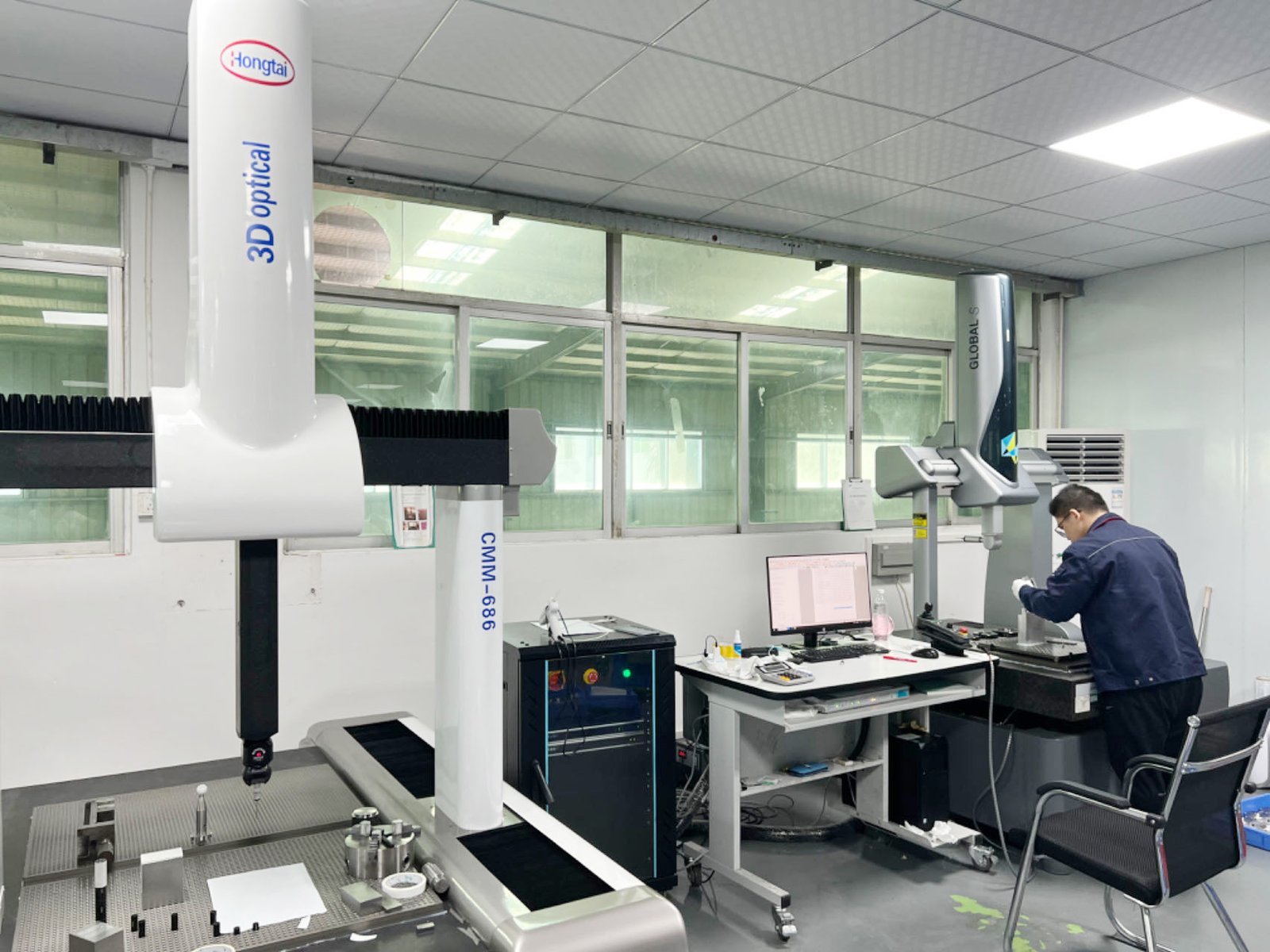
Precision is only valuable if it is proven, and the proof is the measurement. Every critical feature carries an inspection step: a CMM program to measure the positions and geometry, a dedicated gauge for a thread, a roughness tester for a finish. On a part with many critical callouts, the measurement program is real engineering work, and the inspection time can rival the machining time. The measurement overhead is not overhead in the pejorative sense; it is the verification that makes the tolerance meaningful, and it is priced into every serious precision quotation.
Where the drawing carries features at ±0.003 mm, and grinding-grade surfaces at ±0.002 mm with capability tracked at Ppk ≥ 1.67 initial on the criticals, the measurement plan has to prove both the parts and the process. Ask what the report will contain and what it costs, because the report is part of the precision purchase. A buyer who understands that measurement is half the precision price will write drawings that concentrate the critical callouts — paying for verification on the features that matter rather than on every surface of the part. The measurement practice is described on the quality page of this site, where the instruments behind the reports are visible.
Where do material and geometry sit in the precision price?
Material sets the floor of every quotation, and on precision work the stock condition is part of the story. An exotic alloy or a specified heat-treated condition must be sourced, often with a certificate, and its cost sits under the whole part. More subtly, the material affects the precision process itself: hard materials cut slower and wear tools faster, variable material is harder to hold to a tight band, and the material's response to cutting shows up in the yield of the precision features. The material floor and the precision yield are both in the price, and both are the buyer's to specify well.
Geometry interacts with precision through stiffness and reach. A thin wall flexes under the cut and is harder to hold flat; a deep pocket challenges tool reach and limits the tool's accuracy; a large face carries material stress that moves it when the clamps come off. Every geometric feature that makes precision harder is a feature that adds cost, and the drawing that relaxes what function allows — radii, thin walls, deep features — is a drawing that buys precision back where it matters. The parts that best combine material and geometry with precision are shown on the parts page of this site, and their drawings are written to make the precision affordable.
Which quantity effects apply to precision work?
Quantity spreads the fixed costs of precision, which are larger than on ordinary work because the process is engineered rather than improvised. The programming, the fixture design, the tool selection, and the first article carry real cost on a precision part, and they amortize across the run. Per-part price therefore falls as volume rises — but it falls less steeply than on simple parts, because the variable costs of precision — the careful cycle time and the measurement per part — do not shrink with volume. The quantity curve of a precision part flattens sooner, and the buyer should expect that shape rather than the steep drop of a simple turned or milled part.
At low volumes, the fixed-cost share dominates, which is why precision prototypes are expensive per part and why the first article of a precision program carries so much of the price. Where the volume is enough to amortize the engineering, the per-part precision cost becomes the cycle and the measurement, and the quotation should show that the fall is real but bounded. Ask the supplier for the price at your quantity and at a larger one, and read the difference as the amortization of the fixed precision cost — the shape of the curve tells you where the money is, and whether a larger commitment would buy a meaningfully lower price.
How do finishing and coating interact with precision cost?
Finishing adds its own layer to the precision price, and the interaction is where drawings quietly inflate. Anodizing and plating grow the surface, so a precision part that is coated is machined with an allowance and then measured on the finished state — the allowance, the coating, and the re-verification each add cost. Heat treatment can move geometry, so a precision part that is treated is often machined, treated, and then finished or re-verified, and the sequence is priced accordingly. Every treatment after machining is a process with its own handling, its own yield risk, and its own measurement, and it belongs in the quotation as a visible line.
Call the finish where it functions and name the state that is measured, because a sealing surface whose Ra is specified on the base metal is a different specification after a coating covers it. The precision part whose finishing story is written in the drawing — machined allowance, treatment, measured state — is a part whose price includes the real route; the part whose finishing is an afterthought is a part whose price will be revised when the treatment is discovered. On this site the cost model of precision work, including the finishing layers, is laid out on the cost page at high-precision-machining-what-tolerances-and-surface-finishe.html.
How do you compare two high precision quotations fairly?
Precision quotations are compared on the specification inside them, not on the headline number. Two suppliers can quote the same drawing at very different prices because they priced different interpretations: one assumes general tolerances with the critical features tight, another spreads precision across every dimension; one includes the reports and the certificate, another charges them separately; one quotes a process that holds the drawing, another quotes hope. The comparison begins by forcing the quotations onto the same specification — same tolerance assumptions, same inspection deliverables, same material route, same incoterm — and the differences that remain are real.
Read the residual differences as information. A higher quote that names the machine class, the measurement plan, and the capability targets is buying a demonstrated process; a lower quote that repeats the drawing with a price is buying an assumption. The cheapest quotation in precision machining is rarely the cheapest part, because the precision that is not in the price appears later in the inspection, the rework, or the failed assembly. The buyer who compares specifications rather than headlines, who reads the precision layer in each quotation, and who pays for the features that carry function is the buyer who gets precision at its honest price. The factory behind this site, presented on the factory page, quotes and documents precision work under that same honesty, so the comparison a buyer runs against it is a comparison against a real process rather than a promise.
The buyer's rule of thumb: read the precision layer in every quotation, which features are tight, which machines make them, what the measurement costs, and what the report proves. Compare the specification, not the headline, and precision will cost what it earns.
Frequently Asked Questions
What makes high precision machining more expensive than standard machining?
Precision changes the process. Controlled tolerances need better machines, slower and more careful cutting, and measurement at every critical feature; grinding-grade work adds a separate process family. The price difference is the cost of holding and proving the band, and it concentrates on the features that actually carry the tight callouts.
How much does tolerance move the price?
Tolerance moves the price when it moves the process. A feature inside the shop's natural precision band costs little extra; a feature that forces a grinding step or a special process is a step-change in cost. The question is not how tight the tolerance is, but which process it requires, and that is where the money concentrates.
Why is measurement such a large share of a precision quotation?
Because precision without proof is not precision. Every critical feature carries a measurement step, a CMM program, and a report, and on a part with many critical callouts the inspection can rival the machining in time. The measurement overhead is real, and it is why parts that are tight everywhere cost disproportionately more than parts that are tight only where they function.
Does the machine class change the hourly cost?
Yes, and buyers should see it. A precision machining service runs a range of machines — standard 3-axis centers, 5-axis machines for complex geometry, and grinders for the tightest features — and each class carries its own rate. A quotation should make clear which machine class produces which features, because that is where the price comes from.
How does quantity affect a high precision price?
Quantity spreads the fixed costs — programming, fixturing, and the first article — which are larger on precision work because the process is engineered rather than improvised. Per-part price falls as volume rises, but the fall flattens when cycle time and measurement become the constant, so precision parts do not drop in price as steeply as simple parts.
Where does material fit in a precision quotation?
Material sets the floor of the quote, and on precision work the stock condition matters as much as the grade. A heat-treated bar or an exotic alloy that must be sourced with a certificate carries both its own cost and its own risk to the precision process, because hard and variable material is harder to hold to a tight band.
How do I compare two high precision quotations fairly?
Compare the specification inside the quotes, not the headline price. Same drawing, same tolerance assumptions, same inspection deliverables, same material, same incoterm. A quotation that prices every feature at precision grade is not comparable to one that prices only the functional features tight, and the difference is where buyers overpay or misjudge.
Need a precision quotation you can read layer by layer?
Send the drawing through the contact page — the quotation returns with the machine class, the measurement plan, and the tolerance ladder stated feature by feature.